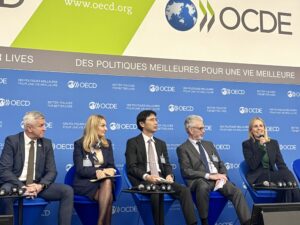
At the end of October, I had the immense privilege as Chair of the Future Farmers Network of representing both Australia and our next generation of farmers on the world stage at the Organisation for Economic Cooperation and Development (OECD) annual Global Forum on Agriculture (GFA), at the OECD headquarters in Paris.
The OECD is an international organisation consisting of 38 member countries (including Australia) which exists to improve the economic and social well-being of people around the world. It does this through establishing evidence-based international standards and policies, including in the realm of agriculture. As an annual platform, the GFA brings together policy makers, experts, farmers and other private sector actors to discuss ideas and solutions, with the 2025 theme being “Attracting New Farmers for the Future of Agriculture”.
The event was attended by senior ministers in agriculture and trade, OECD officials, policymakers, researchers, the President of the World Farmers Organisation and young farmers from across the globe (representing Sweden, Denmark, Austria, Ireland, Cameroon, Kazakhstan, Ghana and Jamaica). The Forum featured a packed agenda, with an aim to rethink together the agricultural profession and the role of policies in making it attractive. To that end, the program included several panel sessions, break-out discussions and a keynote speech from the European Commissioner for Agriculture and Food.
It was extremely interesting to learn about both the similarities and differences many OECD countries are facing in attracting new people to the agricultural sector, particularly given the breadth of experience and knowledge represented in the room. While the similarities are probably unsurprising – such as high land prices, difficulty accessing finance and lack of visible opportunities within the sector – some of the differences were quite striking. From pension systems that discouraged older farmers to retire, to small farm sizes still rendering full-time agriculture as uneconomical in some areas (as an ongoing impact of wars), to land being held so tightly it only changes hands once every few hundred years on average, it was eye-opening to learn about the state of things in other nations.
As the Australian representative on the GFA’s high-level panel, I was asked to discuss how we (in Australia) are attracting new farmers for the future of agriculture. Informed by the results of our FFN survey (issued specifically in preparation for this forum), many conversations with those researching and working in the space, and first-hand experience (from my own perspective and many friends’ and colleagues’), the key points I made included the following:
- The engagement and development of the agricultural sector’s next generation is often led from the bottom up and/or by industry, as opposed to by the Government, through organisations such as the Future Farmers Network, Research & Development Corporations (RDCs) and other local and industry-specific youth-led groups.
- We don’t often address farmers in isolation – the sector is highly integrated, and our initiatives to attract, develop and retain young people often reflect this. The more we broaden the definition of farming and the audience we appeal to, the better our chances of attracting new and top talent both to farms and the sector as a whole.
- Profitability is important – providing opportunity for farming and farming-adjacent businesses to establish, innovate and grow both helps our agricultural sector stay world-leading and efficient, as well as the communities that support it (which are often isolated) to thrive. Reduced red tape, tax incentives and other policy settings which support entrepreneurship are therefore crucial.
- Some of the key challenges we are facing (in addition to distance from services, isolation and equal gender participation, which had already been touched on) include succession, land prices and their intersection, as well as offering creditable training and education to support career progression and pathways.
- We need to flip the script – young people are increasingly seeing the tangible difference they can make and the global solutions they can help solve by pursuing a career in agriculture, from food security to climate change. We need to own that story and refresh our brand so that agriculture is seen for what it is in the 21st
Pleasingly, having attended the GFA, my impression is that Australia is on a relatively positive trajectory as far as attracting new farmers goes, which is supported by statistics showing the average age for farmers has come down in the last 25 years, where in most countries this figure has risen.
This is not to say, however, that we should rest on our laurels; there is much we could learn from the insights, ideas and initiatives presented by our fellow OECD members at the GFA.
In Austria, for example, a national ‘School on the Farm’ educational initiative has become a key component of the curriculum in many areas, connecting children and young people with agriculture and food production by offering half-day or full-day trips to working farms. Perhaps as an extension of this, they have a high number of dedicated agricultural colleges across the country, and perhaps because of this, in turn, Austrians rank farming as the second most highly esteemed career, following medicine.
In an environment where access to land and finance continue to be a major hurdle for young people, novel approaches and programs should continue to be explored. A prime example is Ireland’s Land Mobility Services program, which facilitates collaborative farming arrangements such as long leases, share farming and partnerships to give more new entrants a pathway into the sector.
Focussing on the other end of the age spectrum and ensuring older farmers are well-supported in transitioning out of the sector and handing the reins on to the next generation is equally as important as supporting new entrants. This was identified in the findings of Ireland’s Commission on Generational Renewal in Farming, the report for which was published in September this year.
Several other challenges also need to be addressed if we truly want to be as attractive as possible to the next generation, including gender balance (in which Spain is making great progress through specific initiatives targeted at increasing female participation), agricultural risk-sharing frameworks, better access to support services such as medical care, schooling and ‘relief’ farming (to enable primary producers (particularly those with livestock) to comfortably leave the farm when required), and ensuring administration doesn’t become the key burden of everyday farming.
All of this suggests the need, at a policy level, for a multi-faceted approach to ensure all angles of the issues at hand are adequately considered and the resulting legislation is aligned, for example across pension policy, tax legislation, health policy and education policy. These insights also help organisations like the FFN and our RDCs identify areas that could be explored for future programs (which may be broader than first meets the eye).
I would like to sincerely thank the OECD Trade and Agriculture Directorate for putting on the event, as well as the organisers of the GFA, Ágnes Szuda and Jesús Antón, for designing the Forum’s agenda to ensure young farmers were in the room and engaged with policymakers as much as possible. The importance and impact of including those at the heart of policy in discussions such as the GFA cannot be understated and I would like to commend them both for ensuring this occurred.
I would also like to thank Caroline Wardrop from the Department of Agriculture, Forestry and Fisheries for championing FFN’s involvement, The Honourable Stephen Jones, Peter Creaser, Hubertus Gay and Gaby Coulthard for making me feel so welcome during my visit to the OECD, and in particular Wil Brown for her dedicated support in arranging and helping me prepare for what were a few very big days in Paris. It was wonderful to meet some of the people representing and advocating for Australian agriculture abroad – a group of extremely competent and passionate people who form an important part of our international supply chain – and whose efforts we can all be very grateful for.
A huge thank you also to the Cotton Research Development Corporation (CRDC), who made this trip possible by supporting my attendance through a travel bursary, in particular Rachel Holloway.
Finally, thank you to the FFN team for their support and all members who provided their views via our survey.
FFN Chair
Lauren Roellgen